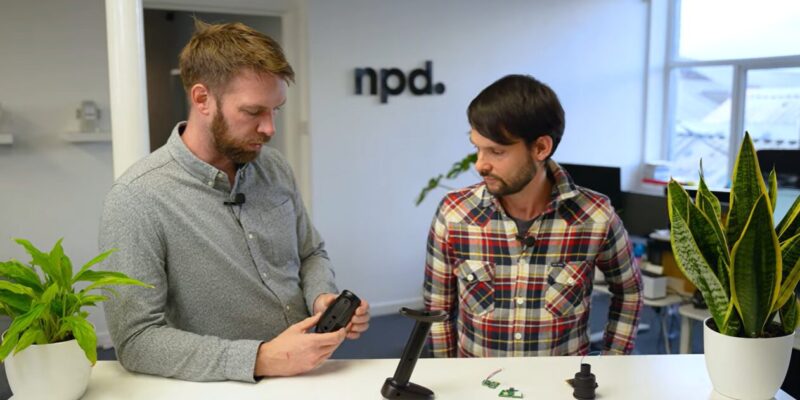
Access to good healthcare shouldn’t be a luxury. Yet across the world, millions of people have never had access to basic eye care – something most of us in the West take completely for granted. Ocuwell is building a solution to that problem. And we’ve had the privilege of working with them to take their prototype and turn it into something that can actually reach those people.
The Brief (And What That Really Meant)
When Ocuwell approached us, they had an advanced prototype. It worked. It proved the concept. But it wasn’t ready for mass production, and that’s where the real work begins.
You see, there’s a massive gap between a prototype that works in a lab and a device that can be manufactured at scale. It’s the gap where most innovations get stuck. The gap where brilliant ideas become expensive, complicated, or simply impossible to make real.
Ocuwell came to us with design for manufacture issues and electronics challenges. On paper, that sounds straightforward. In reality, it meant taking everything their team had built, understanding why they’d made those decisions, then methodically improving it without losing what worked.
The Messy Middle
This is where things get interesting, and messy.
Alex, our Senior Product Design Engineer, walked through the PCB (printed circuit board) and immediately spotted heat dissipation problems. The electronics were generating more heat than the design could handle. So we went through iteration after iteration. First revision. Second revision. By the third iteration, we got it right. But “right” only came after testing, failing, learning, then trying again.
We also discovered component obsolescence issues. One of the key parts we specified? Suddenly it wasn’t available anymore. Supply chains are unpredictable. You can’t anticipate these things at the start, which is exactly why you need to anticipate that you can’t anticipate them.
But here’s what matters: we worked through it. Because the product is too important to get wrong.
The Details That Actually Matter
Most of the meaningful design improvements aren’t visible. They’re the kind of thing that separates a product that works from a product that people actually want to use.
Take hygienic design. The original prototype had a part that contacted the patient’s body – and it wasn’t removable. In a medical device, that’s a problem. So we made it disposable and replaceable. It’s a small change that makes a massive difference in clinical practice.
We also reimagined the exterior material. The prototype was good, but we wanted better. We worked with medical professionals guiding the project and landed on a 3D printing process and material that gives the finished product a sense of quality. We could insert magnets into the design, to allow the camera head to be used in multiple use-case scenarios.
That last bit matters more than it sounds. It’s about user experience. When someone picks up this device for the first time, their interaction with it should feel natural and intuitive. No friction. No confusion. .
Why This Matters
Ocuwell came to us wanting to take a piece of equipment that’s normally huge, expensive, and locked in hospitals, and condense it into something portable, affordable, and accessible. Something that costs a fraction of what a traditional topography device costs.
When this product goes into the world, it’s going to help people see. People who currently have no access to quality eye care.
At npd, we get to pick and choose the projects we work on. We do that deliberately. A big part of why everyone here comes to work each day is to work on products that make a positive difference. Ocuwell is exactly that kind of project. It’s the type of work that makes this job meaningful.
What We Learned
Every project teaches you something. With Ocuwell, it was a masterclass in the gap between prototype and production, and why that gap matters so much. It’s also reinforced something we already believed: the details, the iterations, the willingness to get it wrong so you can get it right – that’s where real product development happens.
It’s not glamorous. It’s not something you see in a portfolio. But it’s absolutely essential.
If you’ve got a product that’s going to make a positive difference to the world, we’d love to be involved. Whether you’re at the prototype stage, scaling to production, or somewhere in between—get in touch. That’s exactly the kind of work we’re here for. Contact us and find out how we can help you or have a look at product design services.
Book a free consultation
